

Every manufacturer has a version of the same problem.
The veteran on your line knows every step by instinct. The right torque spec. Which bin holds which bolt. What a correctly seated part looks like before it moves to the next station. That knowledge took years to build, and it lives entirely in one person’s head.
The newer operator working beside him is doing the best they can with a paper checklist, a two-week onboarding, and whatever they remember from last month’s training session. On a good day, the gap between them is invisible. On a bad day, it shows up as a quality escape, a rework cycle, or a line stoppage that takes an hour to diagnose and a morning to recover from.
That gap between institutional knowledge and actual floor execution, shift after shift, is one of the most expensive problems in manufacturing. It almost never appears on a quality report with a clean label. It shows up as variance. As unexplained defects. As the kind of inconsistency that gets blamed on “operator error” without anyone asking why the error keeps happening.
What if the guidance your best operator carries in their head could travel with every operator, on every shift, in real time?
Guidance at the Moment It’s Needed
The AI Visual Assistant is a smart glasses platform that puts step-by-step operational guidance, real-time inspection capability, and performance coaching directly in the operator’s line of sight — without pulling them away from the work.
Here’s what it looks like in practice.
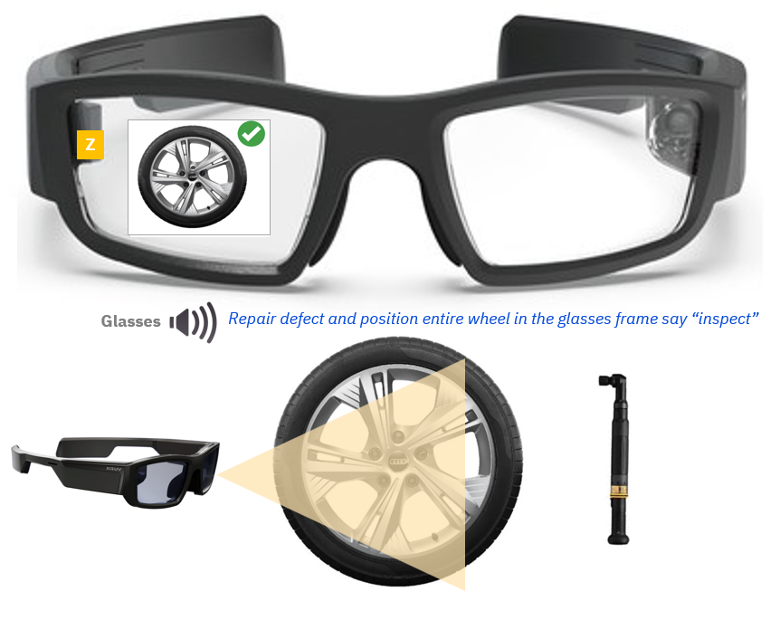
A wheel installation station receives a broadcast signal to begin the workflow for a 22-inch premium rim. The operator puts on the glasses. The system walks them through the sequence:
Step 1 — Verify the rim. The operator frames the full rim in view and says, “inspect.” The AI confirms the correct part. No manual lookup. No chance of pulling the wrong wheel from a busy staging area.
Step 2 — Obtain the lug bolts. The glasses display which bin to pull from and how many. Five bolts, bin three. The operator positions them in the rim, and the system logs the step complete.
Step 3 — Torque all five bolts. As each bolt is torqued, the system captures the readings in real time…79.5, 80.0, 80.0, 79.0, 79.7. Every value within spec. Every value recorded. No clipboard. No manual entry. No question later about whether the job was done right.
Step 4 — Inspect the finished assembly. The operator frames the entire wheel and says, “inspect.” The AI runs a visual quality check. If it detects a defect, the glasses surface it immediately and prompt a repair before the wheel moves downstream, not three stations later when the problem is harder to fix and more expensive to document.
Step 5 — Coaching. After the job completes, the system offers a contextual hint: Try prepositioning the bolts in between vehicles next time to give yourself more time to verify they are the correct bolts. Not a supervisor pulling someone aside. Not a post-shift debrief. Actionable coaching, delivered quietly, at the right moment.
The operator can also pull up on-demand video training mid-shift, refreshing a technique without leaving the line, and check their own performance data on the spot. Average cycle time: 45 seconds. The operator knows where they stand without waiting for a weekly report.
What This Actually Solves
The technology is interesting. The operational problem it solves is more important.
- Consistency across operators. The system doesn’t have a good day or a bad day. Every operator, regardless of experience level, gets the same guidance, the same inspection criteria, and the same quality checkpoint on every unit.
- Quality captured where it happens. Defects caught at the station cost a fraction of what they cost after the vehicle moves downstream. Visual inspection that happens automatically without slowing the line changes the economics of quality control.
- Institutional knowledge that doesn’t walk out the door. When an experienced operator retires or moves to a different facility, their knowledge doesn’t leave with them. It stays embedded in the workflow, available to every operator who works that station next.
- A record that exists without extra work. Torque readings, inspection results, completion timestamps all captured as the work happens. Traceability for audits, compliance, or warranty analysis without asking operators to document anything beyond doing their job.
- Real-time performance feedback. Operators know how they’re doing. Supervisors can see it too. Conversations about performance become grounded in data rather than perception.
The TM Floyd Approach
We don’t show up with a product catalog and a standard implementation plan.
Before we recommend anything, we walk the floor. We look at where quality is inconsistent, where cycle time varies more than it should, where rework keeps appearing without a clean explanation. We identify one station, one high-impact use case where the gap between your best operator and the rest of the line is costing you something measurable.
Then we scope a contained pilot. Focused enough to prove the concept without disrupting production. Structured to generate the data your leadership team needs to make a confident decision about what comes next.
That’s how TM Floyd works across every engagement. Scope before solution. Improvement without interruption. The line keeps running while we make it better.
The AI Visual Assistant has an entry price point designed to make the pilot decision easy. The number that matters more is what a single quality escape, a line stoppage, or a day of rework costs you. In most facilities, the math closes quickly.
The Larger Picture
South Carolina’s manufacturers are under real pressure right now…workforce constraints, tighter OEM quality requirements, margin compression from tariffs and materials costs. The answer isn’t to find more experienced operators. There aren’t enough of them, and the ones you have are being asked to do more.
The answer is to make every operator more effective by building the knowledge and guidance that used to live only in experienced heads into the workflow itself.
That’s what the AI Visual Assistant does. And it’s consistent with what TM Floyd has been doing in manufacturing and critical operating environments for nearly 50 years: keeping the work moving forward, without stopping the line to do it.
Ready to identify the right starting point on your floor? Let’s talk.
About the Author
John Ward is a manufacturing technology advisor and former IBM leader with more than 30 years of experience helping manufacturers improve quality, reduce defects, and increase throughput through practical technology solutions.